

Diccionari de la bicicleta i el ciclisme - Presentación
© Author and publisher: TERMCAT, Centre for Terminology, 2026
In collaboration with: Federació Catalana de Ciclisme
The Diccionari de la bicicleta i el ciclisme (‘Dictionary of Bicycles and Cycling’) is an ambitious work that is still in progress. It takes as its starting point the hosting of three stages of the 2026 Tour de France in Catalonia, but it aims to encompass the entire world of the bicycle. In other words, it covers not only sporting use but also everyday use, as well as recreational cycling and the urban-planning measures designed to protect bicycles and encourage their use.
The reason is that the bicycle is an unsurpassed vehicle in terms of simplicity (and therefore economic cost), efficiency, sustainability and health benefits. It is the foundation of the professional sport of cycling, which attracts worldwide attention during major events, but it is also a highly rewarding leisure activity. Moreover, as a form of active transport, it plays a fundamental role for many years in all cities concerned with sustainability.
Indeed, the bicycle is a masterpiece of design. Its predecessor is usually said to be the draisine of 1817, with a wooden frame and two wheels at either end, propelled by alternately pushing with the feet on either side; its inventor intended it to be a means of transport for the lower classes, but it eventually became a toy for the upper classes. Around the 1860s, pedals were added and it quickly evolved into the penny-farthing, those machines with an enormous front wheel driven by pedals, which allowed the bourgeoisie and aristocracy to show themselves off, enjoy themselves and occasionally injure themselves. This last problem was addressed by the safety bicycle in the 1880s, with wheel sizes that allowed riders to place their feet on the ground and with a chain drive using a chainring and sprocket to power the rear wheel. From 1890 onwards, the design was essentially fixed: spoked wheels fitted with pneumatic tyres, a steel-tube frame and chain transmission. At that point, the falling cost of production finally made the bicycle a popular means of transport.
At present, the Diccionari de la Bicicleta i el ciclisme (focused, as noted, on the Tour de France) contains more than two hundred terms relating to bicycle parts and components, race routes and race progress, and cyclists’ equipment. Nevertheless, TERMCAT continues to work on it with the aim of expanding the racing section to include cyclists’ roles and officiating and, above all, of incorporating urban cycling and urban-planning measures.
Among the sources consulted, stand out the historical TERMCAT Diccionari de ciclisme (published in 1991 on the occasion of the Barcelona Olympics) and the cyclism area of the Diccionari general de l’esport also from TERMCAT (‘General Dictionary of Sport’, published in 2010 with the collaboration of the Unió de Federacions Esportives de Catalunya and updated annually).
Each terminological entry contains the preferred denomination in Catalan and the corresponding synonyms, if any: equivalents in Spanish, French, Italian and English; a definition in Catalan and often explanatory notes. It also includes the thematic area or areas each term belongs to.
Clicking on "Consulta de termes" (‘Term search’), terms can be looked up in three ways: using the alphabetical indexes (there is a different index for each language), using the thematic access or making simple or advanced searches in the upper space "Text de la consulta" (‘Text search’) in any of the dictionary languages.
Downloadable terminolgy at Terminologia Oberta.
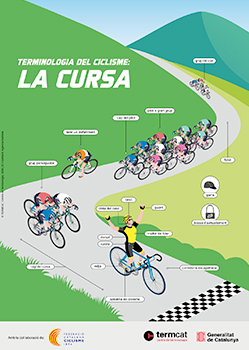
Infographic: Terminologia del ciclisme: La cursa
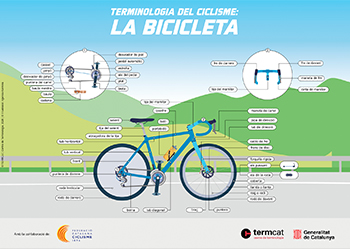
Infographic: Terminologia del ciclisme: La bicicleta
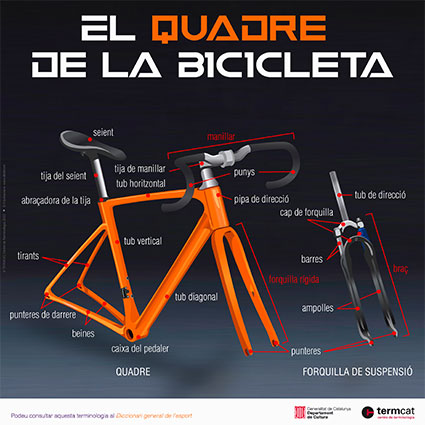
Infographic: El quadre de la bicicleta
Author and publisher:

In collaboration with:
TERMCAT, CENTRE DE TERMINOLOGIA. Diccionari de la bicicleta i el ciclisme [en línia]. Barcelona: TERMCAT, Centre de Terminologia, cop. 2026. (Diccionaris en Línia)
<https://www.termcat.cat/ca/diccionaris-en-linia/359>
